Hacking the Millennium Problem Is Not Solving Turbulence
Recent headlines announced that artificial intelligence had “solved” one of the Navier–Stokes Millennium Problems. In the public mind — and, unfortunately, in much of the mathematical community — this has been conflated with solving turbulence, the oldest unsolved problem in classical physics. These are not the same problem. They are not even the same kind of problem. This post explains the difference, using nothing but the official Clay Mathematics Institute statement of the Millennium Problem, and shows why the celebrated construction, however clever, tells us nothing about turbulence as a natural phenomenon.
Two different questions
The Clay Millennium Problem asks a pointwise, single-trajectory question: given smooth initial data, does the solution of the Navier–Stokes equation remain smooth for all time, or can it break down? It is a question about the idealized equation.
Turbulence is a statistical, many-trajectory question, exactly as Heisenberg framed it in 1948: what is the universal law by which energy distributes itself among an enormous number of degrees of freedom? It is a question about Nature — about the flow in a river, a jet engine, or your morning shower.
What the official problem says about the force
The recent result does not concern the deep, force-free regularity question. In the official statement, the existence-and-smoothness cases (A) and (B) explicitly take the external force “to be identically zero.” The AI construction concerns instead the breakdown cases (C) and (D), in which the equation carries an external force $f(x,t)$.
Now read what the official document says about that force. The components $f_i(x,t)$ are
“the components of a given, externally applied force (e.g. gravity)”
and equation (1) is described as follows:
“Equation (1) is just Newton’s law $f = ma$ for a fluid element subject to the external force.”
The intended picture could not be clearer: a physical force — like gravity — given independently, with the motion following from it. That is the meaning of $f = ma$: the force is prescribed, and the acceleration follows.
There is one more thing the official conditions do, and do not, require of that force. The force must be smooth and rapidly decaying — condition (5) demands $|\partial_x^\alpha \partial_t^m f(x,t)| \le C_{\alpha m K}(1+|x|+t)^{-K}$ for all $\alpha, m, K$. But it is not required to be divergence-free. Only the initial field $u_\circ$ and the solution $u$ are divergence-free, via (2) and (3). The pressure is free to absorb whatever divergence the force carries. This gives a would-be constructor enormous latitude.
The reverse-engineering hack
Consider what this latitude permits. Instead of solving the Navier–Stokes equation for the velocity,
$\dot v = L(v),$
one may choose by hand any velocity field $v(r,t)$ one likes — in particular, one that breaks down at $t=1$ — and then simply define the force to be whatever is left over:
$f(r,t) := \dot v – L(v).$
By construction, this triple $(v, p, f)$ satisfies the Navier–Stokes equation. One has not solved a differential equation; one has solved the tautology $f = f$. The equation — which the official document calls Newton’s $f = ma$ — has been read backwards: instead of the force determining the motion, the motion is chosen first and the force is manufactured to match it.
The only genuinely non-trivial part is to engineer the hand-picked $v$ so cleverly that the induced force $f$ remains smooth — as condition (5) demands — even as $v$ breaks down. This requires a delicate cancellation, at the singular instant, among the time derivative, the convective term, the viscous term, and the freely chosen pressure gradient. It is difficult. But difficulty is not depth. It is a puzzle about manufacturing a velocity field, not a discovery about how fluids move.
The official warning against manufactured motion
This danger is not new, and — importantly — the official problem statement itself warns of it. It recalls the weak solutions of the Euler equations found by Scheffer and Shnirelman, with compact support in spacetime. In the document’s own words, these correspond to
“a fluid that starts from rest at time $t = 0$, begins to move at time $t = 1$ with no outside stimulus, and returns to rest at time $t = 2$, with its motion always confined to a ball.”
The document states plainly that, for the Euler equation, “uniqueness of weak solutions is strikingly false.” These pathologies are raised precisely to explain why the problem demands smooth, classical solutions rather than manufactured weak ones. The reverse-engineered forced singularity is a modern cousin of exactly this pathology: motion — here, a breakdown — conjured to specification, rather than arising from the equation’s own dynamics.
The loophole: no stability is required
Here is the deepest point, and it too rests entirely on the official text. The breakdown cases (C) and (D) ask only for the existence of a single initial field $u_\circ$ and a single force $f$, satisfying the smoothness and decay conditions, “for which there exist no solutions.” The full list of imposed conditions — (4) through (11) — requires smoothness, spatial decay, bounded energy, and periodicity. It says nothing about stability.
There is no requirement that the breakdown be generic. There is no requirement that it survive an infinitesimal perturbation of the initial data. This is the loophole. A singularity engineered for one exact, measure-zero initial condition — and annihilated by the slightest change to that condition — formally satisfies the letter of cases (C)/(D), while describing nothing that could ever occur in Nature.
This is not a flaw in the formulation: for a pure existence question, posed as a rigorous first step, a stability condition would be out of place. But it is exactly the gap that separates a mathematical existence result from a physical law — and it is the gap the reverse-engineering exploits.
Why this is not physics — three reasons
It reads Newton’s law backwards. The official gloss on equation (1) is Newton’s $f = ma$, with the force “given, externally applied (e.g. gravity).” The manufactured force is instead computed from the very trajectory it is meant to produce, tuned in advance to a future breakdown. Natural forces — gravity, the Lorentz force — are prescribed independently of the flow; they do not adapt themselves to steer a fluid toward a prescribed singularity.
It is not stable. Take the same engineered force and solve the equation from slightly different initial data. The delicate cancellation that kept $f$ smooth was tuned to one specific trajectory; any perturbation destroys it. The construction has not been shown to be Lyapunov-stable — and by its nature cannot be.
Physical flows are never deterministic. No real flow has a perfectly prescribed initial velocity; every real fluid carries thermal fluctuations. A breakdown that exists only for a single measure-zero initial condition, and vanishes under the tiniest perturbation, is invisible to Nature. Without a proof of stability, such a “solution” says nothing about any physical flow.
The real turbulence problem — and a candidate solution
The genuine problem is the one Heisenberg and Kolmogorov posed: the universal statistical law of the turbulent flow. This is the problem I have worked on, and I will describe its status honestly — as a candidate solution (described in my previous blog post) under active scrutiny, not a finished monument.
My approach reformulates the Navier–Stokes statistics exactly — with no external force and no added noise — as a dynamics in loop space: the functional analysis of the Hopf characteristic functional, expressed through periodic functions of bounded variation. This is the mathematics of gauge and string theory, unfamiliar to most applied mathematicians, which is part of why the work has been slow to reach its natural readership. An exact solution of this loop equation was long presumed impossible, though no proof of impossibility was ever given.
The result is, in every respect, the opposite of the reverse-engineered construction — it is what a natural law should look like:
- The singularity is at $t = \infty$: an essential singularity of the statistical attractor, arising spontaneously from smooth data, with no external force.
- Its structure is governed by the non-trivial zeros of the Riemann zeta function — the same objects that govern the distribution of the primes. The zeta function is not inserted by hand; it emerges from the arithmetic of the loop closure. This is a genuine bridge between two branches of mathematics that had no prior relationship: the analysis of a nonlinear PDE and analytic number theory.
- It is confirmed by direct numerical simulation at $4096^3$ resolution (with K. R. Sreenivasan and collaborators), to within a relative $\chi^2$ of order $10^{-3}$.
And — directly answering the objection raised above — recent analysis establishes the Lyapunov stability of this statistical solution, precisely the property the forced construction lacks. The attractor comes in two arithmetic families, an Euler-odd and an Euler-even ensemble, with distinct limits as $N \to \infty$; the physically relevant odd ensemble is marginally stable. A statistical law that is stable under perturbation, requires no external force, and matches simulation is the exact opposite of a singularity that is destroyed by any perturbation and driven by a force manufactured to produce it.
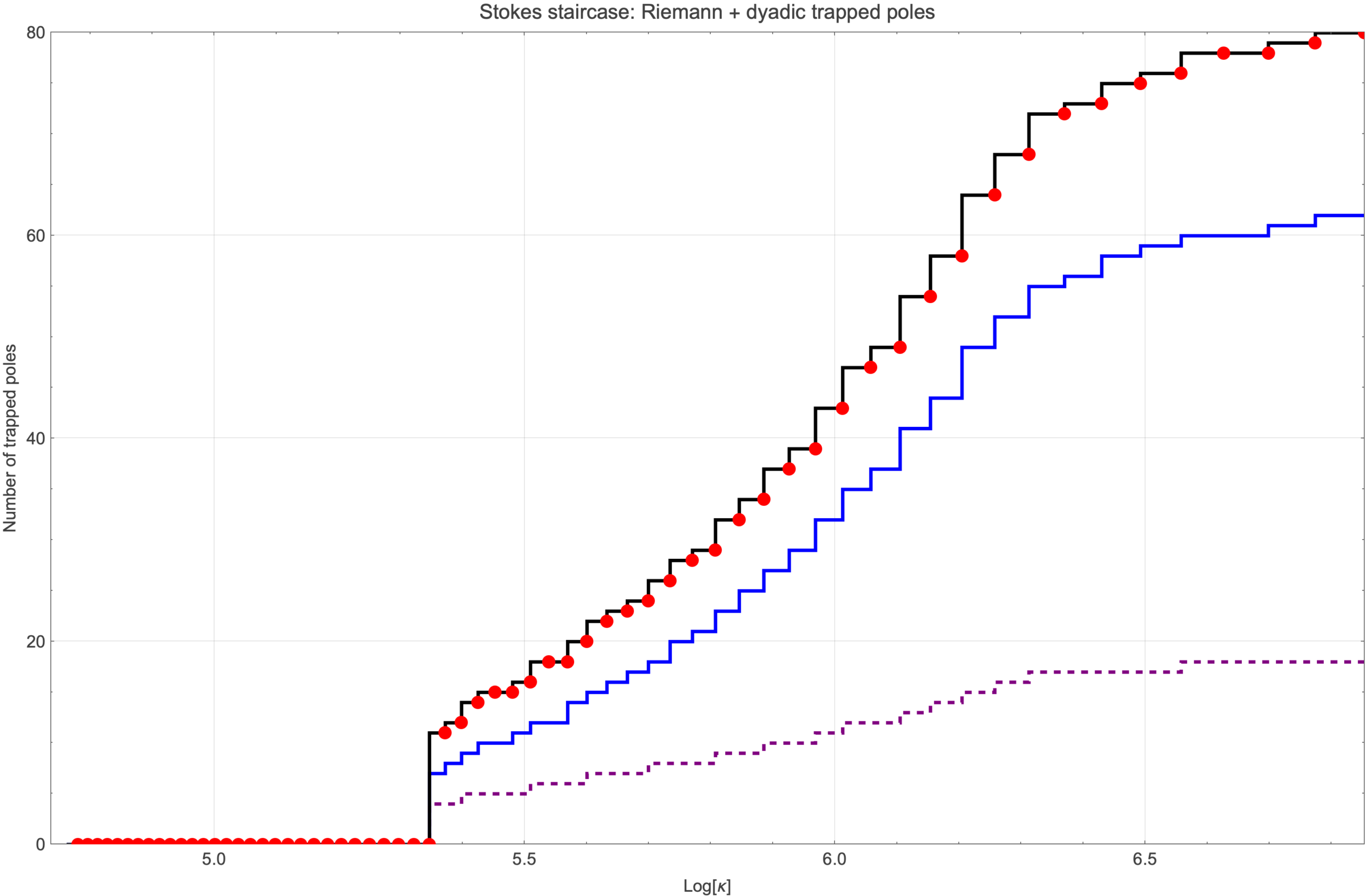
\[
\boxed{
\begin{gathered}
\text{Navier–Stokes statistics}
\;\longrightarrow\;
\text{loop equation}
\;\longrightarrow\;
P(\theta,t)\in S^{d-1}
\\[4pt]
\longrightarrow\;
\frac pq
\;\longrightarrow\;
\varphi(n)
\;\longrightarrow\;
\frac{\zeta(s)}{\zeta(s+1)}
\\[4pt]
\longrightarrow\;
\text{Riemann-zero poles}
\;\longrightarrow\;
\text{Stokes staircase}
\;\longrightarrow\;
t=\infty\text{ singularity}.
\end{gathered}}
\]
\[
\boxed{
t_n \sim \frac{\rho_n^3}{2\pi e^3\,\tilde\nu\, k^2}
\sim \frac{4\pi^2}{e^3\,\tilde\nu\, k^2}\left(\frac{n}{\ln n}\right)^3
}
\]
The distinction, stated plainly
Solving a Millennium breakdown case is a theorem about what the idealized equation permits when you drive it with a tailored force — a force that, in the reverse-engineered version, runs Newton’s law backwards. Proving such a statement is a genuine feat. But it is not, by itself, the turbulence problem.
Turbulence is a law of Nature: spontaneous, self-organized, statistically universal, stable, and observable in every real flow. That is the problem physics has sought for a century — and it is the one that, remarkably, turns out to be written in the language of the Riemann zeros.
Hacking the Millennium Problem is a puzzle about what an equation allows. Solving turbulence is a discovery about what the world does. Let us not mistake the first for the second.